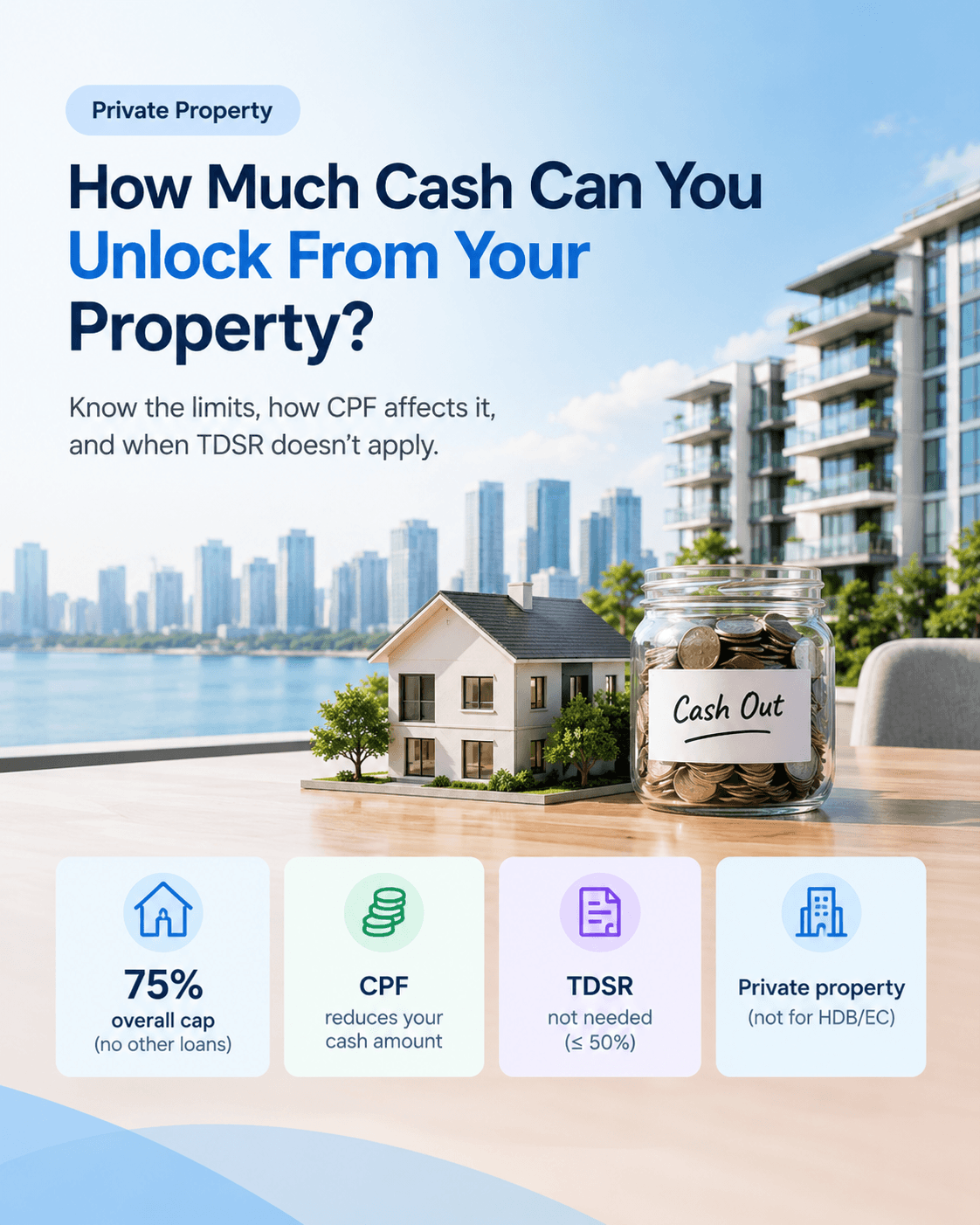

How Much Cash Can You Unlock From Your Property?
How Much Cash Can You Unlock From a Private Property?
Quick answer
With no other housing loans, the overall cap on borrowing against your private property is 75% of its current valuation. The maximum new equity loan is the remaining headroom after subtracting your outstanding mortgage and CPF used for the property. For an initial estimate, include both CPF principal withdrawn and accrued interest. If you have another housing loan, the overall cap is 45%. TDSR does not apply when the new equity loan plus existing loans secured on this property totals 50% of its valuation or less. The bank still assesses your ability to repay.
The question that matters
How much of your property’s value is already committed — to the bank and to your CPF account? That decides how much cash is left to unlock, and whether your income has to pass TDSR at all.
The limits at a glance
| Rule | Limit |
|---|---|
| Overall cap: no other housing loans | 75% of current valuation |
| Overall cap: one or more other housing loans | 45% of current valuation |
| What counts inside the cap | The new equity loan + outstanding loans on this property + CPF monies used for it. HLW includes CPF principal and accrued interest in its initial estimate; the lender confirms the actual figure |
| TDSR | Does not apply if the equity loan plus other loans secured on the property total 50% or less of valuation |
| Maximum tenure | 35 years |
| Property type | Private property. Not available on HDB flats, or on ECs still within their minimum occupation period |
Home Loan Whiz | Final approval requested
How cash-out works
A cash-out or equity term loan is a separate loan secured on your property. You keep your existing mortgage and take the new loan alongside it. Banks typically pay it out in one sum.
MAS calls these mortgage equity withdrawal loans. Two things set your limit:
- The overall cap. Your current valuation, multiplied by 75% (or 45%), minus what’s already committed to the property.
- Your income. At or below the 50% line, MAS exempts the loan from the TDSR calculation, but the bank still assesses your ability to repay. Above 50%, TDSR applies; your total debts must fit within 55% of income, tested at a 4% rate.
Equity loans are treated as investment property loans, even when they’re secured on the home you live in. That matters if you refinance them later.
Worked example: $2M property, $600,000 still owed
Illustration — not a client case. A homeowner has a private condo valued at $2,000,000. They still owe $600,000 on it. They withdrew $300,000 of CPF principal to buy it, with an assumed $60,000 of accrued interest. They have no other housing loans. The actual accrued interest must be checked against the CPF statement.
| Step | Amount |
|---|---|
| Overall cap: 75% × $2,000,000 | $1,500,000 |
| Less outstanding mortgage | –$600,000 |
| Less CPF principal and assumed accrued interest | –$360,000 |
| Illustrative maximum you can unlock | $540,000 |
| Portion with no TDSR check: 50% × $2,000,000 − $600,000 | $400,000 |
| Portion above the no-TDSR line | $140,000 |
Up to $400,000 falls within the TDSR exemption, subject to the bank’s credit assessment. Borrowing above that, up to the illustrative $540,000 cap, requires passing TDSR. The 50% test counts loans secured on the property, not the CPF amount; the separate LTV cap includes the CPF amount. The final limit depends on the lender’s assessment.
If the same owner also had a mortgage on another property, the cap would fall to 45%: $900,000 less the $600,000 existing mortgage and $360,000 illustrative CPF amount leaves no additional headroom.
Before you apply
- Get a current valuation. The cap is based on today’s value, not what you paid.
- Check your CPF principal and accrued interest for the property on your CPF statement.
- Decide whether you need more than the 50% line. If not, TDSR doesn’t come into it.
- Count your other housing loans. One more loan anywhere drops the cap from 75% to 45%.
- Plan the repayment. It’s a loan secured on your home, so missed payments put the property at risk.
Home Loan Whiz | Final approval requested
Frequently asked questions
Can I do this on an HDB flat?
No. MAS rules don’t allow these loans on HDB flats, or on ECs still within their minimum occupation period.
Why does my CPF reduce the amount?
MAS counts CPF monies used for the property inside the same LTV cap as your loans. For an initial HLW estimate, include principal withdrawn and accrued interest. Confirm the amount your lender uses.
Is it the same as refinancing?
No. Refinancing replaces your existing mortgage. A cash-out loan is a separate loan taken on top of it.
Do I need to say what the money is for?
MAS rules set no restriction on use, but ask the bank about its own requirements.
How much can you unlock?
Send us the property type and estimated value, your outstanding loan, the CPF principal and accrued interest for the property, any other housing loans, and your age and income. We’ll estimate the cap and whether TDSR applies.
Related guides
Sources: MAS — Mortgage Equity Withdrawal Loan Rules; MAS — Written reply on mortgage equity withdrawal loans, 14 January 2026; MAS — Refinancing an MWL. Rules as at 10 October 2026.